
Quick Read
Dashboard warning lights are color-coded by urgency: red means stop immediately, amber means get it checked soon, and blue or green is just information. In Pakistan, the most dangerous lights to ignore are oil pressure (can destroy your engine in minutes), coolant temperature (especially brutal in Lahore's 47°C summers), and the Brake System Warning. The check engine light is the most common and most ignored - and in Pakistan it has specific triggers like CNG usage, low-grade fuel, and monsoon ECU moisture that most generic guides don't cover. When a red light comes on, pull over. When an amber light comes on, book a checkup within the week. Don't do the "chalta hai, kal dekhte hain" thing - the repair bill only grows.
You're driving down Canal Road, music playing, traffic moving for once. Then something lights up on your dashboard. It's orange. Or red. You glance at it, think "probably nothing," and keep driving.
Two days later, you're at a workshop paying Rs 80,000 for a repair that would have cost Rs 8,000 if you'd stopped when the light first appeared.
This happens constantly in Pakistan, and it's not because drivers are careless. It's because nobody ever properly explained what those lights mean, how urgent each one is, or what to actually do when one appears. A generic guide from a UK or US website isn't much help either - they don't account for CNG conversions, Lahore's summer heat, monsoon flooding, or the fuel quality realities here.
This guide does.
We'll walk through every significant dashboard warning light, explain what it actually means (not just the icon name), tell you how urgently you need to act, and flag the Pakistan-specific situations that make certain lights more common or more serious here than abroad.
The Color System: How Urgency Is Coded
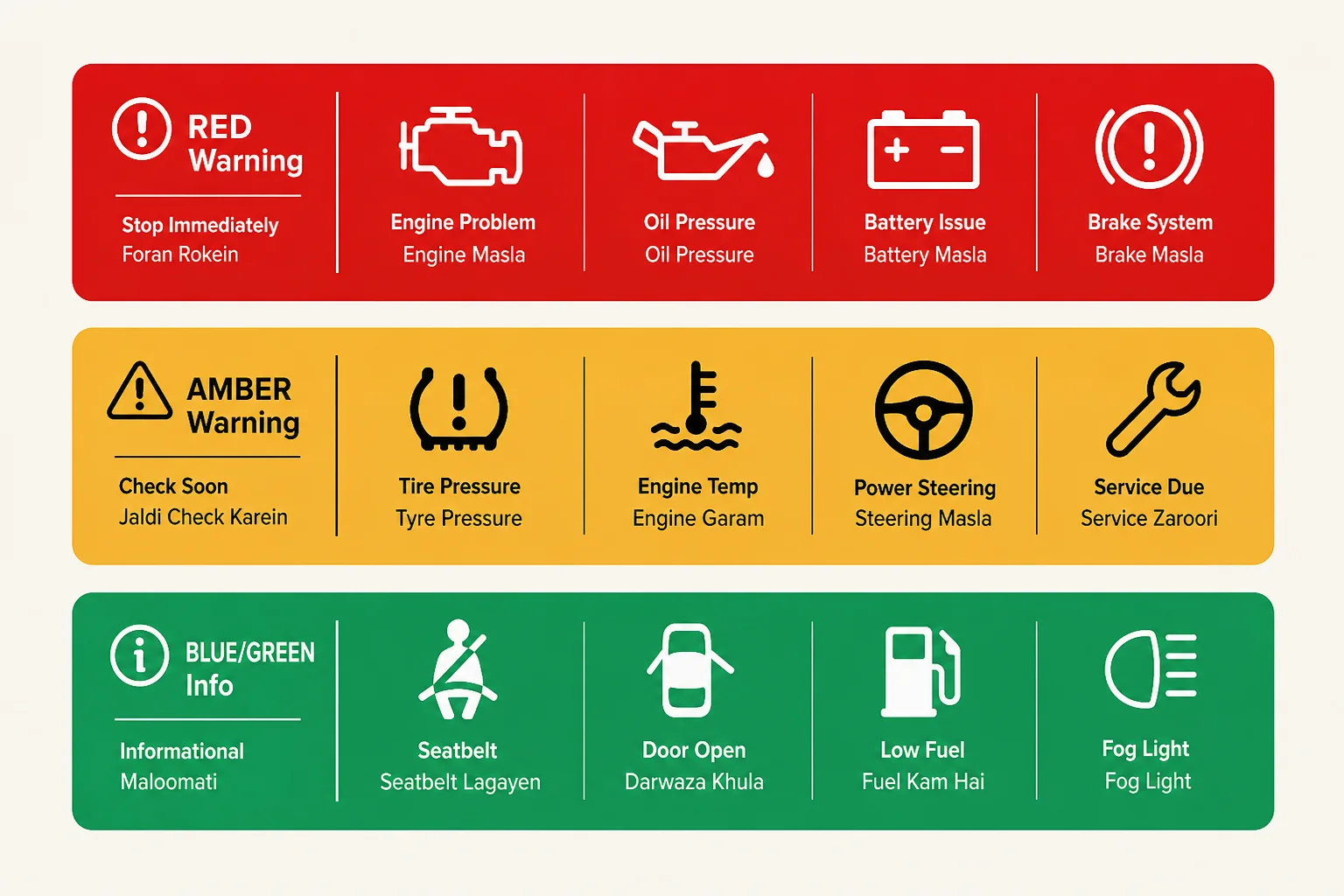
Before getting into specific lights, understand the color logic. It's consistent across virtually every car brand sold in Pakistan:
Red means stop. Not "watch it." Not "get it checked." Stop the car, turn off the engine. A red warning light indicates an active problem that can cause serious - sometimes irreversible - damage if you keep driving. Oil pressure and coolant temperature in red territory can destroy an engine in under 10 minutes of driving.
Amber or orange means something is wrong, but not immediately catastrophic. You can usually complete your journey, but you need to get it looked at within a few days. Ignoring amber lights long enough turns them into red situations.
Blue and green are informational. High beams are on. A door is open. Your seatbelt isn't fastened. These aren't faults - they're status indicators.
White or grey varies by manufacturer, but usually also indicates status or a minor notification.
The rule of thumb: if you see red, treat it like a petrol gauge on empty in the middle of the motorway. You don't keep driving and hope.
Red Warning Lights
These lights indicate active, serious problems. When any of these appear, especially if they stay on rather than flash briefly at startup, pull over safely as soon as possible.
Oil Pressure Warning
What it looks like: An old-fashioned oil can, sometimes with a drop falling from the spout.
What it means: Your engine's oil pressure has dropped dangerously low. Oil is what keeps all the metal surfaces inside your engine from grinding against each other. Without adequate pressure, those surfaces make contact. The damage is rapid and often catastrophic - seized pistons, destroyed bearings, scored cylinder walls.
How urgent: Extremely. You have minutes, not hours. Pull over and turn off the engine immediately.
Don't confuse it with: The oil level indicator (a different symbol, usually just the oil can without the pressure context). Low oil level is serious too - but Oil Pressure Warning means the system has already failed, not just that you're running low.
This light appears more often here due to extended oil change intervals. Lahore's summer heat (temperatures regularly hitting 45-47°C) accelerates oil breakdown. If you're still on a 10,000 km interval with Pakistani road and heat conditions, your oil may be losing viscosity and pressure-holding ability well before that mark. We cover this in detail in our guide on how often to change engine oil.
What to do: Stop, turn off the engine. Check your oil level once the engine has cooled (10-15 minutes). If the level is fine and the light persists, you likely have an oil pressure sensor fault or a pump issue - don't restart without a mechanic's input. If the level is low, add oil and see if the light clears. Either way, get it properly diagnosed before driving distance. AutoSpot's mechanical repair team can diagnose whether it's a sensor, a pump, or something more serious.
Engine Temperature/Coolant Warning
What it looks like: A thermometer submerged in wavy lines (representing coolant).
What it means: Your engine coolant is overheating. Coolant circulates through the engine to absorb heat and carry it to the radiator. When coolant temperature exceeds its operating range, you're heading toward engine damage - warped cylinder heads, blown head gaskets, or a cracked block in serious cases.
How urgent: Very. Pull over within a few minutes. Don't wait for the next exit if the gauge is climbing into red.
This is one of the most common serious warning lights in Lahore during summer. The combination of stop-and-go traffic (barely moving on M M Alam Road at 2pm), ambient temperatures over 45°C, and often-neglected cooling systems means overheating is a real risk for a large percentage of cars here. We've written a full guide on car engine overheating in Lahore, covering causes, diagnosis, and prevention in detail.
What to do: Pull over and turn off the engine. Do NOT open the radiator cap while the engine is hot - the pressurized steam will burn you. Let it cool for at least 20-30 minutes. Once cool, check the coolant reservoir level. If it's empty or very low, top up with distilled water as a temporary measure and get to a workshop. If it was at the right level, the issue is likely the thermostat, radiator, water pump, or a leak somewhere - all need professional diagnosis.
Battery/Charging Warning
What it looks like: A rectangle with plus and minus terminals (the universal battery symbol).
What it means: Your car's charging system isn't maintaining adequate voltage. This usually points to the alternator (which charges the battery while the engine runs), the battery itself failing, or a loose/corroded connection. A car running on battery alone - without the alternator charging it - will keep going for 20-40 minutes before dying completely.
How urgent: High. Don't turn off the engine if you're far from help - you may not be able to restart it. Drive directly to a workshop.
Battery failures accelerate in Extreme Heat. A battery that would last four years in a temperate climate may die in two years here. Hot weather depletes battery cells faster and increases the rate of electrolyte evaporation. In summer, if your battery is over 2.5-3 years old and you see this light, suspect the battery first.
What to do: Reduce electrical load immediately - turn off AC, lights, and anything non-essential. Drive directly to a workshop. If the car dies, you'll need a jump start. AutoSpot's electrical repair services cover alternator testing and battery replacement.
Brake System Warning
What it looks like: An exclamation mark inside a circle, sometimes with the word "BRAKE" underneath, or the letter "P" in a circle (for parking brake).
What it means: If the parking brake is released and this light is still on, there's an issue with your hydraulic brake system. This could be low brake fluid, a leak in the brake lines, ABS sensor failure, or a problem with the brake master cylinder.
How urgent: Extremely. Brakes are safety-critical. If you notice any change in how your brakes feel - sponginess, longer stopping distances, pulling to one side - alongside this light, stop immediately.
What to do: First, confirm the parking/handbrake is fully released. If the light stays on, check brake fluid level (it's in a small reservoir under the bonnet, marked MIN/MAX). If it's low, that indicates either normal long-term pad wear (as pads wear, the caliper pistons extend further, pulling more fluid from the reservoir) or a leak. In either case, get it inspected. Do not ignore a brake warning light.
Power Steering Warning
What it looks like: A steering wheel with an exclamation mark, sometimes with wavy lines indicating fluid.
What it means: In hydraulic power steering systems, this usually means low power steering fluid or a pump issue. In electric power steering (EPAS) systems - increasingly common in newer cars - it indicates an electronic fault with the system.
How urgent: High. You can still steer without power assistance, but the effort required increases dramatically, especially at low speeds. In a moment of emergency, reduced steering response can be dangerous.
What to do: For hydraulic systems, check the power steering fluid reservoir. If it's low, there's a leak somewhere in the system - top up and investigate. For electric systems, this typically needs an ECU scan to identify the fault code.
Amber Warning Lights
These lights don't require you to stop immediately, but they do require attention within the next few days. Ignoring them is how amber situations become red ones.
Check Engine Light (CEL)
What it looks like: An engine silhouette, sometimes with a lightning bolt through it, or the words "CHECK ENGINE."
What it means: This is the most commonly seen and most commonly ignored light in Pakistan. When your car's onboard diagnostic system (OBD-II) detects a fault in the engine management system, fuel system, emissions system, or dozens of other sensor circuits, it stores a fault code and lights the CEL. The light itself tells you nothing about which fault - only a diagnostic scanner reading the fault codes can do that.
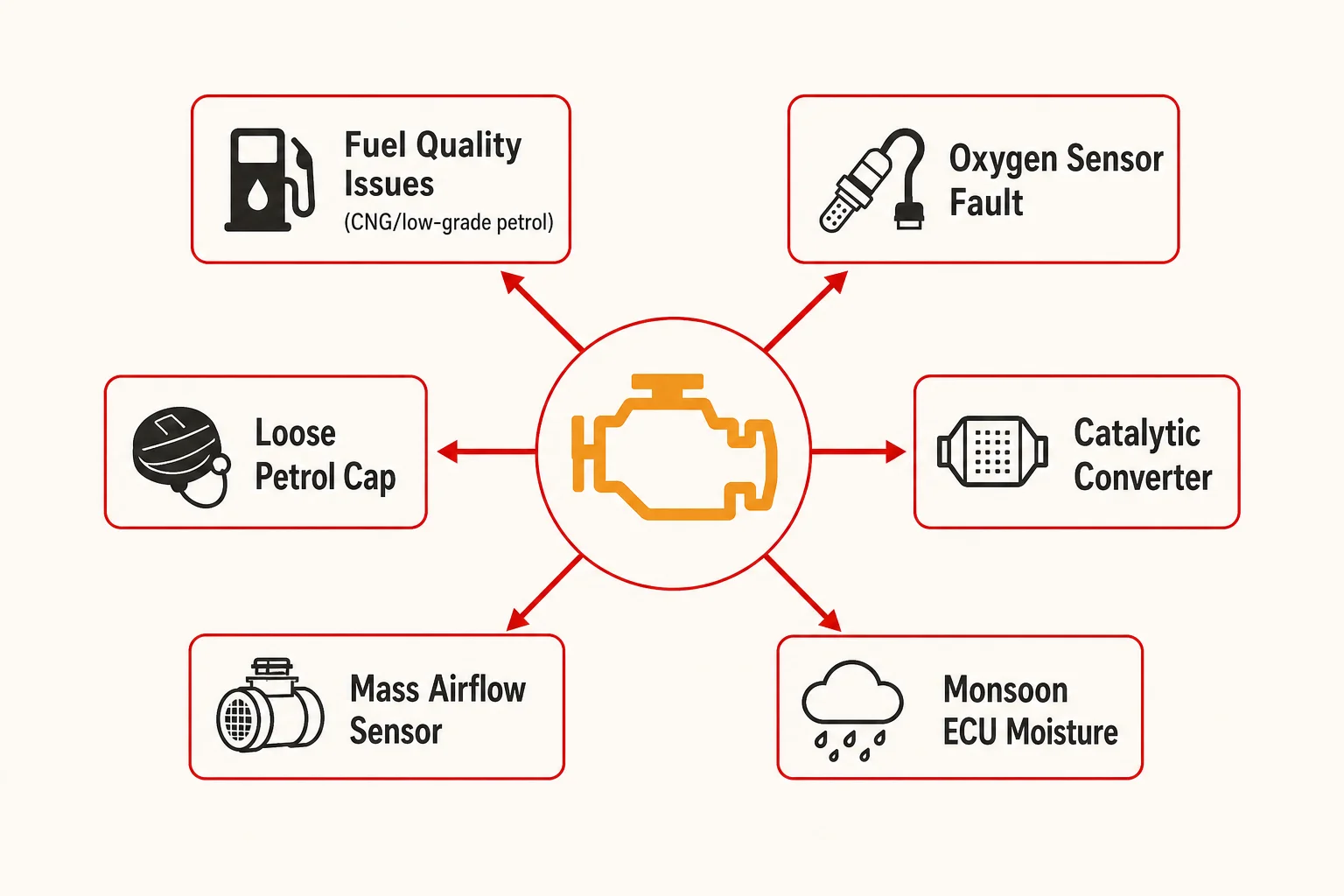
This light has unique triggers here that are rare in other markets:
- CNG Conversion Systems often interfere with the stock fuel management. Sensors expecting petrol composition readings get confused by CNG combustion signatures. Many cars here have a permanently-lit CEL because of a poorly calibrated CNG kit.
- Low-grade or adulterated fuel triggers oxygen sensor faults and catalytic converter codes. The sensors are calibrated for a narrower fuel quality range than what sometimes comes out of Pakistani pumps.
- Monsoon flooding - water entering the engine bay or ECU housing causes short circuits that trigger multiple codes simultaneously.
- Loose petrol cap - the evaporative emission system detects pressure loss from a loose cap and logs a fault. This is one of the most common CEL triggers globally, and the easiest fix.
How urgent: Amber for a steady light, higher urgency if blinking. A blinking CEL specifically indicates active engine misfiring - the kind that can damage the catalytic converter quickly. Blinking CEL should be treated closer to a red light.
What to do: Get a diagnostic scan done. Any reputable workshop with an OBD-II scanner can read the fault codes in a few minutes. This tells you exactly what triggered the light instead of guessing - and potentially replacing parts that weren't the problem.
Tire Pressure Warning (TPMS)
What it looks like: A cross-section of a tire with an exclamation mark inside, sometimes with the letters "TPMS."
What it means: One or more tires have dropped below the recommended pressure. In some cars like Changan Alsvin, it doesn’t show you the exact tire that has low pressure - even one low pressure tire will give the low tire pressure warning on both the instrument cluster and infotainment screen.
Pakistan context: Lahore's roads are punishing. Potholes, rough surfaces, and speed bumps that arrive with no warning all accelerate tire wear and increase the risk of sidewall damage that causes slow leaks. TPMS lights come on frequently here.
What to do: Check all four tires (and the spare if your system monitors it) with a gauge. Inflate to the pressures listed on the sticker inside your driver's door frame or in the owner's manual. The light should clear after driving for a few minutes once the pressures are correct. If the light keeps returning, you have a slow leak - get it inspected.
Engine Oil Level/Service Warning
What it looks like: Similar to the Oil Pressure Warning (oil can symbol), but usually amber, or a wrench symbol indicating scheduled service.
What it means: The amber oil light (as opposed to the red pressure light) indicates your oil level has dropped below the minimum. The wrench or service indicator means you've hit your scheduled service interval.
What to do: For low oil, check and top up. For the service indicator, book a service. Don't confuse this with the red oil pressure light - the urgency is different.
ABS Warning
What it looks like: The letters "ABS" in a circle or rectangle.
What it means: Your Anti-lock Braking System has a fault. Your normal brakes still work - this isn't the same as a brake failure. But you've lost the ABS function, which prevents wheel lock-up during hard braking and maintains steering control in an emergency stop.
Pakistan context: ABS sensor faults are common after flooding and waterlogged roads. The wheel speed sensors are positioned near the wheel hubs where they're exposed to water and debris.
What to do: Get it diagnosed. Regular braking still works, but in an emergency hard-brake situation, your wheels may lock up. Drive more cautiously until it's fixed.
Traction Control/Stability Control Warning
What it looks like: A car with squiggly tire tracks, sometimes with the letters "TC," "TCS," or "ESC."
What it means: If it flashes briefly during acceleration - especially on slippery or loose surfaces - that's normal. The system is working and intervening. If it stays on, there's a fault in the system.
What to do: A persistent light needs a diagnostic scan. Some vehicles share sensors between ABS and traction control, so this light may come on alongside an ABS warning.
Airbag/SRS Warning
What it looks like: A person with a circle in front (the airbag deployed position), sometimes with "SRS" (Supplemental Restraint System).
What it means: There's a fault in the airbag or seatbelt pre-tensioner system. The airbags may not deploy correctly in a collision.
How urgent: This one deserves more urgency than a typical amber light. You're fine driving, but the safety system you'd need in an accident may not work correctly. Get it diagnosed soon.
Fuel Level Warning
What it looks like: A petrol pump icon, often with an arrow indicating which side your filler cap is on.
What it means: You're low on fuel. Most cars have 4-8 litres remaining when this illuminates.
Pakistan context: Fuel availability is generally good in Lahore, but on motorway stretches or in areas with load shedding affecting pumps, it's worth not pushing this one. Also, running a fuel tank very low repeatedly can stress the fuel pump - the pump uses fuel itself for cooling and lubrication.
Power Steering Fluid Warning (Hydraulic Systems)
What it looks like: A steering wheel with wavy lines beneath it indicating fluid.
What it means: Power steering fluid is low. Look for a leak under the car or at the reservoir. Low fluid means the pump is working harder and hotter, accelerating wear.
Glow Plug Warning (Diesel Engines)
What it looks like: A coil heater symbol, usually amber.
What it means: One or more glow plugs have failed. Glow plugs pre-heat diesel engine cylinders to enable cold starting. In Lahore's temperatures, a failed glow plug rarely prevents starting - but it signals that other engine management issues may follow.
Informational Lights: Just So You Know
These lights are status indicators, not warnings. They confirm a system is active or remind you of something.
What To Do When a Light Comes On: A Quick Decision Guide
The single most important decision is how fast you need to act.
Note: If your handbrake/e-brake/parking brake is engaged, you’ll see a red light as well. Most cars will start beeping loudly as well. Just disengage it and keep on driving.
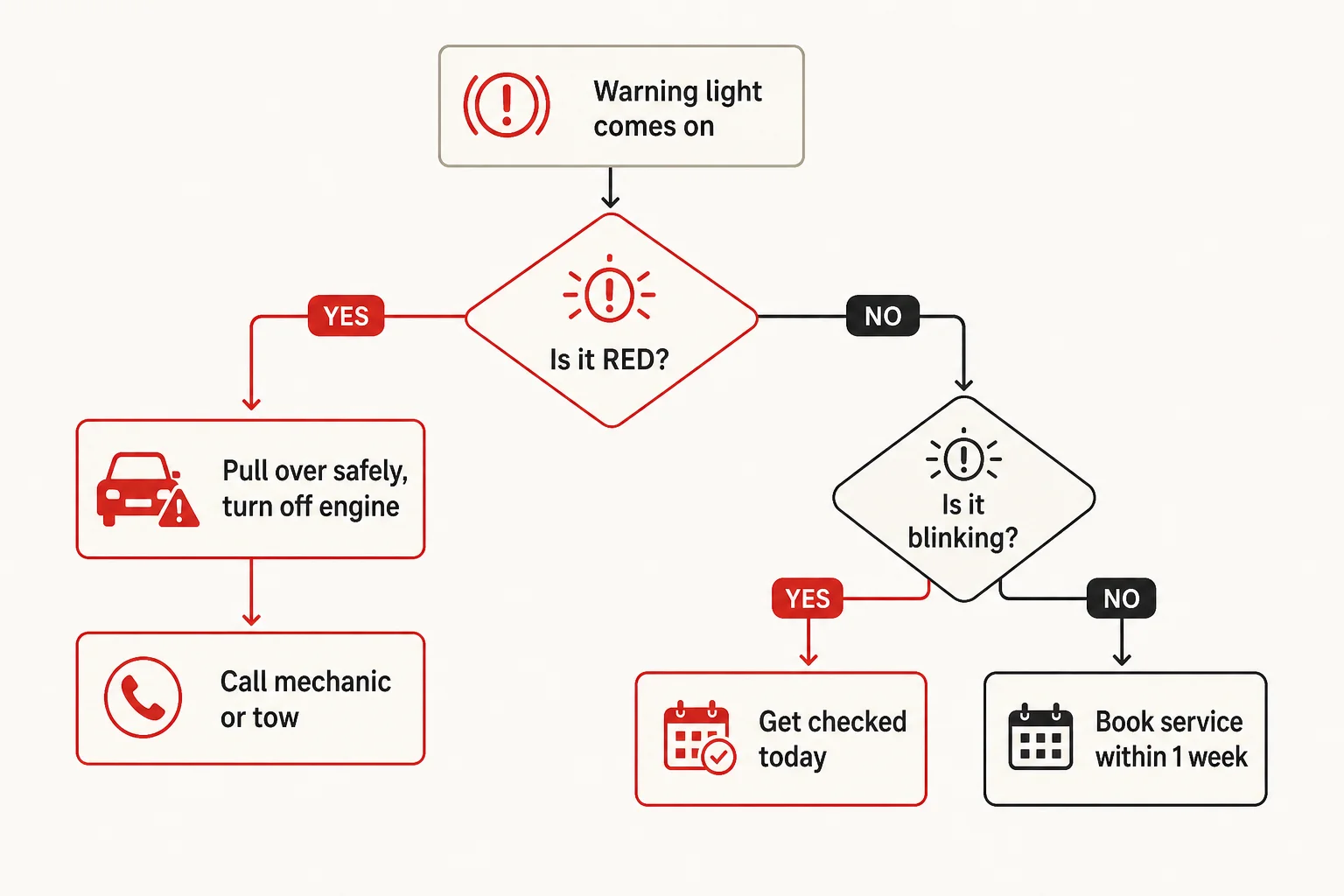
If the light is red: Pull over safely and turn off the engine. Don't restart and try to "see how it goes." Call a mechanic or arrange a tow. The most expensive workshop visit you'll ever have is the one for the engine you destroyed by driving through a red warning light.
If the light is red AND blinking: Same as above, higher urgency. Get off the road immediately.
If the light is amber and steady: You can continue your journey. Book a diagnostic scan within the next few days. Don't put it off for weeks.
If the light is amber and blinking: More urgent than a steady amber. Get it looked at today or tomorrow.
If multiple lights come on simultaneously: This usually points to an electrical fault (alternator, battery, fuse) affecting multiple systems. Don't continue driving. Multiple simultaneous lights are rarely a coincidence.
Specific Situations That Trigger Warning Lights
Some warning light scenarios are particularly common in Pakistan and worth knowing.
After Monsoon Flooding
Lahore's monsoon season - July through September - regularly floods roads, sometimes to wheel-arch depth or beyond. Water in the wrong places triggers a cascade of warning lights:
- Water in the engine bay can short electrical connectors and sensor wiring
- ECU moisture causes multiple simultaneous CEL codes
- Wheel speed sensors (ABS, traction control) fail when submerged
- Air filter moisture triggers fuel mixture faults
If you've driven through a flood and warning lights appear in the days after, have the full electrical system
inspected. Don't assume it's a false alarm.
CNG Conversion Systems
Some vehicles run CNG in Lahore. Pakistan has seen an 83% decline in CNG since 2012. Conversions vary enormously in quality - a well-calibrated kit from a reputable installer rarely triggers warning lights, but cheaper kits or kits installed by inexperienced technicians frequently cause:
- Persistent check engine lights from oxygen sensor confusion
- Mixture and fuel trim faults stored in the ECU
- Premature wear on catalytic converters (which aren't designed for CNG combustion byproducts on petrol-spec systems)
If your CEL appeared after a CNG installation or has been on since you switched to CNG, the first step is getting the kit properly recalibrated.
Extreme Heat
During peak summer (May-August), certain faults become significantly more common:
- Coolant temperature warnings from degraded coolant or radiator issues
- Oil Pressure Warnings from oil viscosity breakdown
- Battery warnings from increased electrical load (full-blast AC in 47°C heat puts serious strain on the alternator and battery)
Pre-summer cooling systems and battery checks can help prevent many of these. Even if you are not getting these checks done you should keep an eye on your car's temperature gauge during the summer.
The Expensive Mistake: Ignoring Check Engine Light

The check engine light (CEL) has a credibility problem in Pakistan. Because it triggers frequently - CNG kits, minor sensor faults, loose petrol caps - many drivers start treating it as permanent background noise.
"Mine has been on for two years, the car drives fine."
The problem: the CEL is a single warning indicator for hundreds of different fault codes. While some codes are genuinely minor (the loose petrol cap situation), others are early warnings of serious developing problems. Once you've trained yourself to ignore the CEL, you lose the ability to notice when it's telling you something that actually matters.
A diagnostic scan at a reputable workshop takes 15-20 minutes and tells you exactly which fault code is stored. That's the difference between a petrol cap tighten and Rs 80,000+ for a catalytic converter replacement you delayed too long.
How to Read Your Dashboard
Every car sold in Pakistan comes with an owner's manual. Most are in the glovebox, ignored. The manual has a section - usually titled "Instrument Cluster," "Warning Lights," or "Indicators" - that shows every light for that specific vehicle with explanations.
Why it matters: not every car uses exactly the same symbols. A symbol that means one thing in a Toyota may have a slightly different meaning or urgency in a Suzuki or Honda. The manual is the definitive source for your specific car.
If you bought a used car and the manual is missing, search "[your car make and model] owner's manual PDF" - most manufacturers have them freely available online. And if you're still in the process of buying, read our guide on how to inspect a used car before buying - dashboard warning lights are one of the first things to check before handing over any money.
Try AutoSpot.pk
When a dashboard light does require professional diagnosis or repair, AutoSpot is Lahore's full-service workshop for exactly this kind of work. With 8+ years of experience, a 4.6-star Google rating from 445 reviews, and certified mechanics on staff, the team handles everything from a quick ECU diagnostic scan to full engine and electrical system repairs.
Services directly relevant to warning lights:
Open Monday through Saturday, 11 AM to 9 PM. Located at 46-R Shah Alam Road, Block R Phase 2, Johar Town, Lahore. You can call on +92 331 4899966, WhatsApp on +92 310 4102888, or email hello@autospot.pk. Pickup and drop-off available from anywhere in Lahore.
Book a diagnostic or inspection at AutoSpot!