Quick Read
Buying a used car in Lahore without inspecting it is one of the most expensive mistakes you can make. Anyone can learn to spot the obvious red flags - mismatched paint, warning lights, suspicious odors - but the hidden stuff (chassis damage, ECU faults, compression issues) needs a professional. Do the basic checks yourself to filter out the obvious lemons, then book a professional pre-purchase inspection before you sign anything. The inspection costs a fraction of what a surprise engine or suspension repair will set you back.
You finally found it.
A clean Civic, good color, low mileage. The photos online look great. The seller sounds relaxed and confident. You go to see it in DHA, and honestly - it looks perfect. The seller says what they always say:
"Sir, genuine car. Just buy and drive." Or all that “Army officer/Lady doctor driven” nonsense.
You buy it. You feel good about it.
Then, 3 weeks later, your mechanic tells you the bonnet has been replaced after an accident, the air conditioning compressor is about to fail, and there's a small but persistent oil leak from the engine gasket that's going to cost you six figures to fix properly.
This story isn't unusual.
It plays out across Lahore every week - on Jail Road, in Johar Town, in Defence. The car looked fine. The photos were clean. The seller wasn't even necessarily dishonest. Sometimes they genuinely didn't know. Sometimes they did. Either way, the repair bill is yours now.
The good news? A lot of this is preventable. You don't need to be a mechanic to spot the signs of a problematic used car. You just need to know what to look for - and when to call in someone who knows more than you do.
This guide walks you through both.
Why You Should Never Buy A Used Car Without Inspecting It
N E V E R.
Let's be direct: used car sellers in Pakistan are not running a charity. That doesn't mean they're all dishonest - many genuinely don't know every issue with their car. But the used car market in Lahore is informal, largely unregulated, and full of vehicles that have been cosmetically refreshed to hide deeper problems.
Here's how it happens:
A car gets into an accident. The owner gets it repaired at a small roadside workshop - dent removal, some filler, and a coat of paint. The car looks presentable again. It gets listed online or sold to a dealer. The dealer details it inside and out. It gleams.
Nothing about its appearance tells you what happened six months ago.
Or consider this: a car has an oil leak. The seller knows about it. Before you come to inspect, they pour a bottle of engine oil additive, give the engine bay a quick clean, and the leak is temporarily masked. You check the oil - it's at the right level. You drive it for 30 minutes, and everything feels fine. Six weeks later, you're back at a workshop, spending money you didn't budget for.
Dashboard warning lights are another one. Did you know those can be cleared with a basic OBD scanner (that's the diagnostic tool mechanics plug into your car)? A check engine light that's been glowing for weeks can be switched off in sixty seconds. Sellers do this. Some of them don't even understand what the light meant - they just knew it would put buyers off.
The financial stakes are real.
In Pakistan's used car market, you're typically talking about millions of rupees. A hidden structural issue - damage to the chassis (the main metal frame of the car) - can cost several hundred thousand rupees to repair properly. An automatic transmission overhaul on a popular car like the Toyota Fortuner or Honda Civic can run into the same territory. A car that looked like a deal can quietly become a money pit.
The answer is not to avoid buying used cars. Used cars are a completely sensible choice, especially in this economy. The answer is to inspect before you buy.
Start With The Exterior
The outside of a car is where sellers put the most effort when they're trying to hide something. A fresh wash, some polish, and a careful detail can make a twenty-year-old car look almost new. That's fine - but it can also hide things.
Here's what to look for when you walk around the car.
Check The Paint Carefully
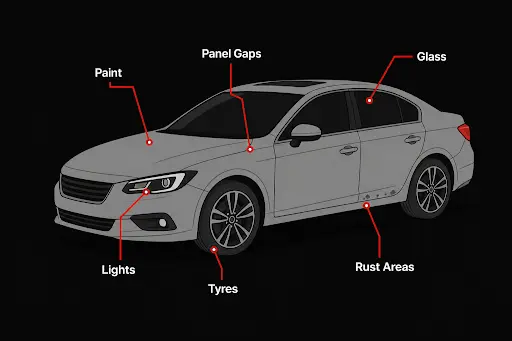
Stand back a few meters and look at the car from different angles. Does the color look consistent all the way around, or does one panel look slightly different from the others? A mismatched panel is often a sign that part of the car was repainted after an accident.
Run your hand lightly across the surface of the panels. Does it feel smooth and even everywhere, or are there areas that feel slightly rough, wavy, or uneven? Uneven texture often means body filler (a putty-like material used to smooth out dents before painting - also called ‘puteen’). One or two tiny touch-ups are normal. Large areas of filler are not.
Pro tip: Inspect the car in daylight, not in a dim garage or at night. Artificial lighting hides paint inconsistencies that daylight reveals immediately. If a seller asks you to look at the car in the evening, that's worth noting.
Check The Panel Gaps
Walk along the side of the car and look at the gaps between panels - between the door and the bumper, between the bonnet and the headlight, between the boot and the rear quarter panel. These gaps should be even and consistent. If they're wider on one side than the other, or if a panel looks like it's sitting slightly out of alignment, the car may have been in an accident that bent the frame.
Note: Some cars have panel gaps as a manufacturing defect, e.g. the 2020 Hyundai Tucson.
This sounds technical, but it's actually one of the easiest things to spot once you know what you're looking for.
Look For Rust
Pakistan's climate is tough on cars. The dusty roads of Lahore, the summer rains, and the way water collects in wheel arches and under-body cavities all accelerate rust. Check the lower sections of the doors, the wheel arches, and the underside of the car if you can see it. Surface rust (small orange patches) is cosmetic. Deep rust that has eaten through the metal is structural and expensive.
Common mistake: Many buyers only look at what's visible. Rust under the carpets, inside the spare wheel compartment, or in the boot floor is easy to miss - but it's often a sign the car has been in water. Flood-affected cars are a real risk in Lahore, especially after the monsoon season.
Tires And Alignment
Check all four tires for tread depth and wear pattern. If the tires are wearing unevenly - more on the inside edge than the outside, or more on one tire than another - it usually means the car has an alignment problem. Alignment issues sometimes point to suspension damage that the seller hasn't mentioned.
Also check for tire age. tires have a manufacture date stamped on the sidewall (it looks like a four-digit code: the first two digits are the week, the last two are the year). A tire older than five years is worth replacing regardless of how much tread remains.
Lights And Glass
Test all the lights - headlights, taillights, indicators, reversing lights. Make sure they all work. Cracks in the windscreen or windows are worth noting because they spread, and glass replacement in Pakistan can be surprisingly expensive for some models.
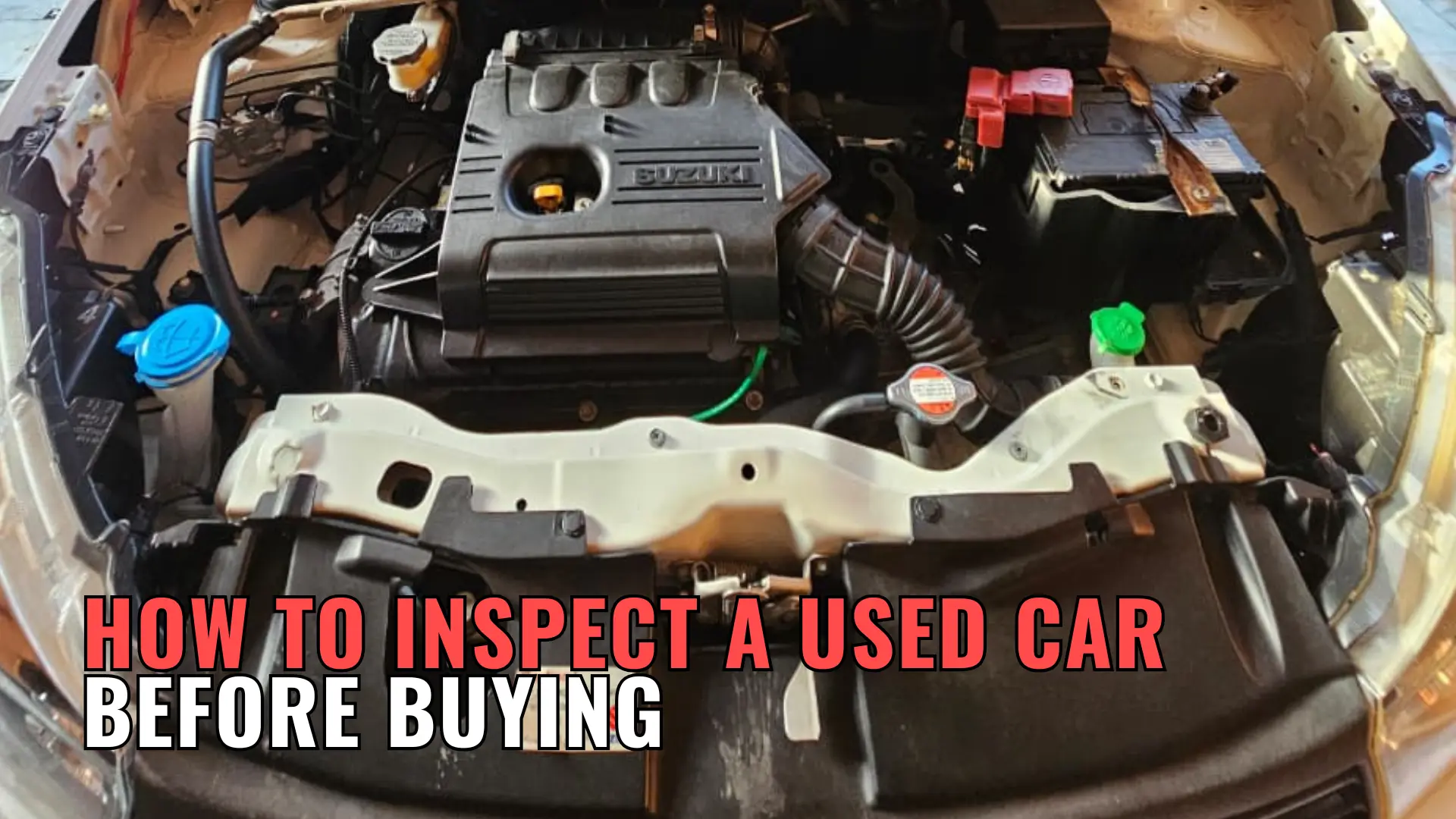
Check Under The Hood
Opening the bonnet makes a lot of buyers nervous. They don't know what they're looking at, and they're afraid of looking foolish. But you don't need to understand how an engine works to spot the things that matter. You just need to know what "normal" looks like.
Ask the seller to open the bonnet before you start the car. A cold engine tells you more than a warm one.
Engine Oil
Pull the oil dipstick (it usually has a yellow or orange loop handle). Wipe it, reinsert it fully, then pull it out again. The oil level should be between the two marks on the stick. More importantly, look at the color and consistency. Fresh oil is golden-brown. Old oil is dark brown. Black, sludgy oil means the car has gone too long without an oil change - not a disaster, but a maintenance concern.
Our guide on how often should I change engine oil covers the right intervals for Pakistani driving conditions.
If the oil looks milky or foamy, that's serious. It usually means water has got into the engine, which can indicate a blown head gasket (an expensive repair). Don't buy a car with milky oil without understanding exactly why.
Coolant
There's usually a plastic reservoir near the front of the engine bay labelled with a temperature symbol. Check the level. It should be between the MIN and MAX marks. Also look at the color - coolant is usually green, pink, or blue. If it's brown and murky, the coolant hasn't been changed in a long time. Most people use water instead of coolant. Don’t do that unless you want a rust filled cooling system.
Pro tip: Never open the radiator or coolant reservoir cap when the engine is hot. The pressurised fluid can spray and cause burns. Wait for the engine to cool, or just check the overflow reservoir level from the outside.
Leaks
Look at the ground under the car, and look at the bottom of the engine. Are there any wet spots, stains, or fresh oil patches? A small amount of surface dust or grease buildup is normal on an older car. Wet, actively-dripping oil is not.
Belts And Battery
Look at the rubber belts in the engine bay. They should be smooth and intact with no visible cracks or fraying. A snapped timing belt (the belt that synchronises the engine's internal moving parts) can destroy an entire engine in seconds - and replacing it before it breaks is a routine maintenance task that a responsible owner would have done.
Check the battery terminals for white or green corrosion buildup. A corroded battery is sometimes just old age, but heavy buildup can also indicate the car has had electrical issues.
Smell And Smoke
With the engine cold, ask the seller to start it while you stand behind the car and watch the exhaust.
Thin white smoke on a cold morning is normal - that's just water condensation.
Thick white smoke means your engine is burning coolant.
Blue smoke suggests the engine is burning oil, which is a sign of worn piston rings or valve seals.
Black smoke suggests the fuel mixture is wrong.
These are not good signs on any car.
Also, pay attention to smells around the engine bay. A sweet smell can indicate a coolant leak - our guide on car engine overheating in Lahore explains what happens when coolant levels drop, and the engine starts to run hot. A burning smell suggests something electrical. Any unusual smell is worth asking about directly.
Inspect The Interior
The interior of a car tells you a lot about how it was used and maintained - and whether it's ever been through water. Responsible car owners always keep their car interiors clean.
Wear patterns
Look at the driver's seat, the steering wheel, and the pedals. Do the wear levels match the mileage on the odometer? A car claiming 40,000 km should have a moderately worn driver's seat and some light wear on the pedals. If the car claims very low mileage but the steering wheel is cracked and the seat is heavily worn, the odometer may have been tampered with.
Common mistake: Buyers often focus on the digital or physical odometer reading and take it at face value. Odometer tampering is real and happens in Pakistan's used car market. Wear patterns are your cross-check.
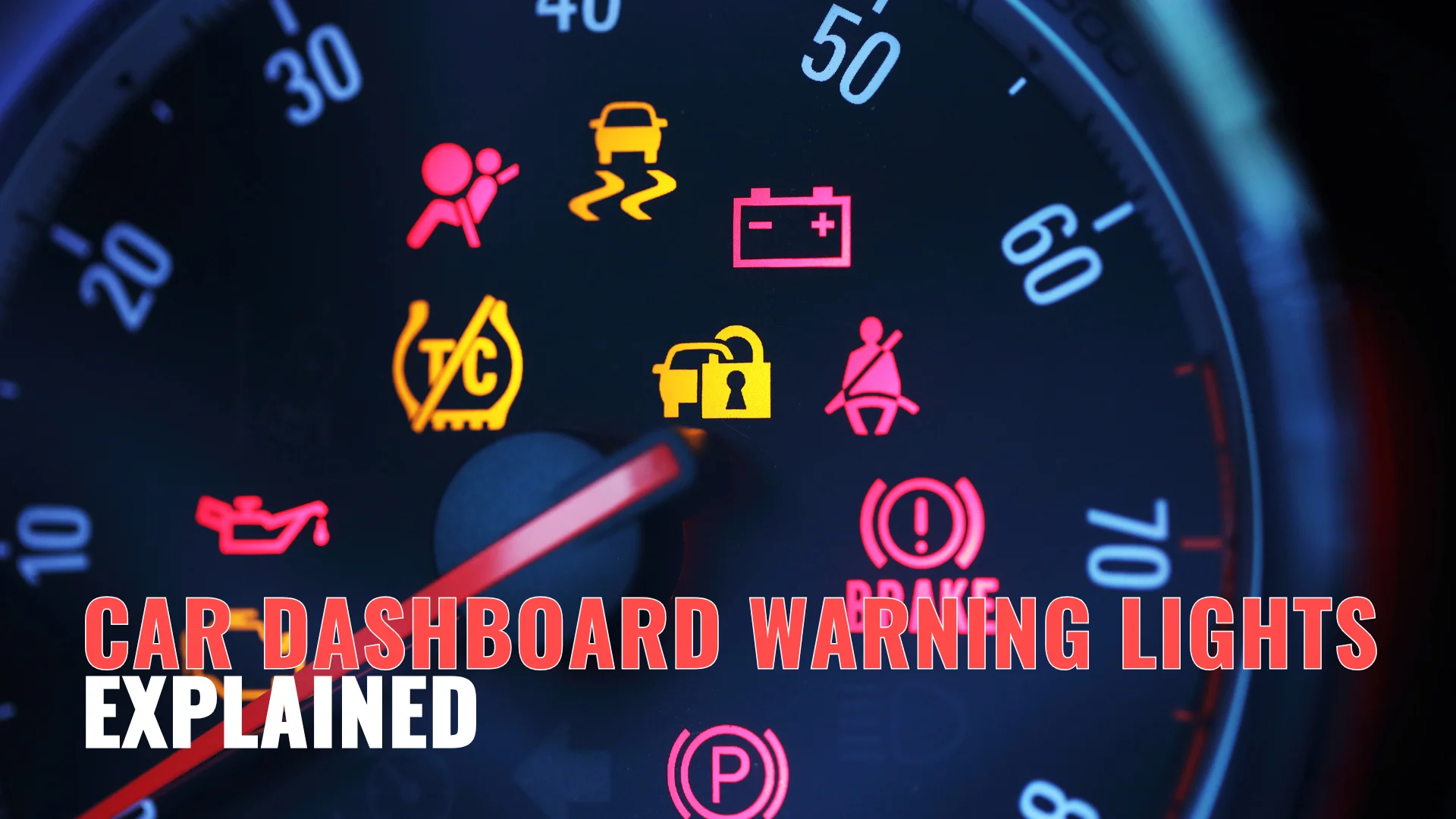
Dashboard Warning Lights
Turn the ignition to the "on" position without starting the engine. All the warning lights on the dashboard should light up briefly - this is a self-test. Now start the engine and let it settle. Any warning lights that stay on after startup are active alerts.
Common ones to worry about: the engine check light (shaped like an engine outline), the battery warning, the oil pressure warning, or any transmission warning lights.
Some sellers will have cleared these before you arrive. If a light stays on, ask directly what it means. If the seller doesn't know or becomes evasive, that's a red flag.
Electronics
Test everything. Power windows - all four of them. The air conditioning - critical in Lahore's summers, and the reasons your car AC is not cooling are more varied than most buyers expect, with repair costs anywhere from 30,000 to over 100,000 rupees, depending on the issue. The infotainment system. Every button on the steering wheel. The heated or ventilated seats, if the car has them. Seat belts on all seats - do they lock properly when you pull them sharply?
Signs of Flood Damage
This is particularly important in Lahore, where flooding after heavy monsoon rains is a real event. Flood-damaged cars can be dried out and sold without obvious signs - for a while. But the damage to the electronics, the wiring, and the structural metal catches up eventually.
Look for water stains under the carpets and along the door sills (lift the carpets at the edges). Smell the interior carefully - a musty or damp smell that the detailing hasn't fully covered is a telling sign. Check the seat belt mechanism points - water often leaves mineral deposits around metal parts that stay damp. Look at the bottom of the seats for rust that wouldn't typically appear there.
Pro tip: If the car has been flooded, the fuse box (usually under the dashboard or in the engine bay) may show signs of water damage or corrosion. Ask to see it.
Take It For A Test Drive
A test drive is not optional. You learn more in fifteen minutes of driving than in an hour of standing next to a car.
Ask the seller to let you drive for at least 15-20 minutes, covering a mix of slow traffic and faster stretches. Lahore's roads - from the slow crawl of Jail Road traffic to a slightly faster stretch on a main boulevard - give you a good range. Be wary of sellers getting hesitant about you driving. It’s not always the case of “Petrol mehnga hai.”
What To Listen For
Turn off the music and drive in silence for a while. Listen for:
- Knocking from the engine - especially noticeable at startup or under acceleration. A deep knock from the bottom of the engine is serious.
- Clunking when going over bumps - this usually points to worn suspension components or loose ball joints (the joints that connect the wheel assembly to the suspension).
- Squealing or grinding when braking - squealing can mean worn brake pads. Grinding usually means the pads are completely worn, and the metal is contacting the disc. Both need attention.
- Vibration at speed - a car that shakes when you accelerate past 60 km/h may have wheel balance, alignment, or tire issues. It could also indicate something more serious with the driveshaft.
What To Feel For
- Steering pull - does the car pull to one side when you drive in a straight line? This suggests an alignment issue or potentially unequal brake pressure.
- Gearbox hesitation (automatic cars) - automatic transmissions should shift smoothly and without delay. Hard shifts, slipping between gears (the engine revs but the car doesn't accelerate as expected), or unusual jolts are warning signs.
- Brake confidence - press the brakes firmly at a safe opportunity. The car should stop evenly and in a straight line. If it pulls to one side, the brakes may need attention.
What To Look For After The Drive
Park the car for two minutes after the test drive, then look at the ground underneath. Any fresh drips? Also look at the exhaust: check if there's any residue or staining around the pipe, which can indicate ongoing burning or leaks.
Don't Forget The Documents
In Pakistan's used car market, the paperwork is as important as the mechanical condition. A car with great engine health but problematic ownership history can cause you serious headaches.
Original Registration Book
The original log book (registration document) must be present. Not a photocopy. Not a duplicate issued by the excise department. The original. A seller who only has a photocopy or a duplicate book is a red flag. It means either the original was lost (which sometimes indicates insurance claims or legal disputes) or something else is going on.
Engine Number And Chassis Number
These are stamped directly on the car's body - the engine number on the engine block, and the chassis number on the firewall (the metal panel between the engine bay and passenger cabin) or the door sill area. They must match exactly with what's written in the registration document.
If they don't match, do not buy the car under any circumstances. This is non-negotiable.
You can also verify the vehicle's registration against Punjab's official DLIMS portal to check ownership history, token tax status, and whether the car has any police or court cases against it.
Token Tax and Traffic Challans
Are those paid? Unpaid token tax becomes your problem the moment you transfer the car into your name. Ask for the receipt showing it's been paid for the current year. Same goes for traffic challans.
Transfer history
How many owners has the car had? Frequent transfers can SOMETIMES indicate a car that keeps developing problems. One or two previous owners over several years is normal. Five previous owners in three years is worth questioning.
Service history
Does the seller have any service records? A car with documented maintenance history - oil changes, timing belt replacements, manufacturer-recommended services - is almost always in better condition than one without. Many sellers in Lahore won't have this, but it's worth asking.
Common mistake: Buyers get caught up in negotiating the price and forget to verify documents before agreeing. Verify documents first, negotiate second.
Common Red Flags That Should Make You Walk Away
Not every used car inspection ends with a negotiation. Sometimes the right answer is to walk away.
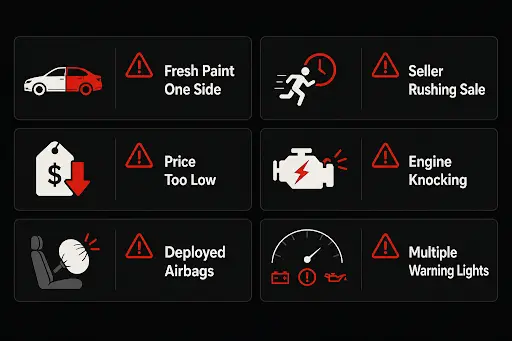
Here are the situations that should make you hesitate - or leave entirely:
Fresh paint on one panel only. One shiny new panel next to faded factory paint almost always means accident repair. A good repair job might be acceptable, but an undisclosed one is not.
The seller is rushing you. "Just decide today - I have two other buyers coming." This is a pressure tactic, and legitimate sellers don't need it. A good car will still be there tomorrow.
The price is significantly below market. Check online listings for comparable cars. If the price is 20-30% below what similar cars are selling for, ask yourself why. Sometimes it's a genuine deal. More often, it's because the seller knows something you don't yet.
Engine knocking. A deep, rhythmic knock from the engine - especially at idle or under light acceleration - means serious internal engine wear. Read our full breakdown of engine knocking sound and how to fix it to understand what you're likely dealing with. This is an expensive problem.
Uneven tire wear. Heavy wear on the inner edge of the front tires usually means the suspension geometry is off, sometimes after a collision.
Airbags already deployed. Check by pressing gently on the steering wheel centre and the dashboard in front of the passenger seat. They should feel firm and solid. A soft or inconsistent feel may mean the airbag has already gone off and been stuffed back in rather than properly replaced. Airbag replacement is expensive - typically over 100,000 rupees - and a deployed-but-unreplaced airbag is a genuine safety risk.
Multiple dashboard warning lights. One warning light might be a minor sensor issue. Multiple lights suggest the car has significant problems, and it's possible the seller has cleared some and not all of them.
Water damage you can smell. If the car smells musty inside even after detailing, or if you see rust in places that shouldn't have rust on a Lahore car, take the flood damage possibility seriously.
No original documents. Already covered above. No original log book, no deal.
What You Can Check Yourself - And What You Probably Can't
Let's be honest about this.
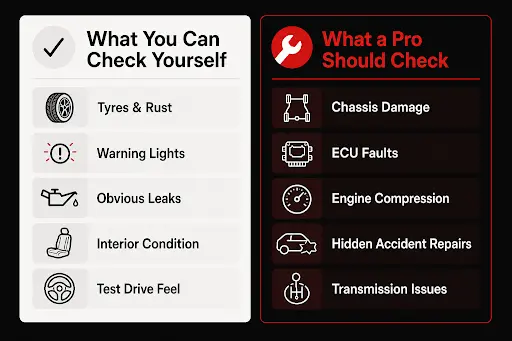
After reading everything above, a careful buyer can identify:
- Paint inconsistencies and obvious accident repairs
- tire condition and wear patterns
- Obvious fluid leaks
- Dashboard warning lights
- Flood damage signs in the interior
- Basic document verification
- How the car feels on a test drive
That's actually a solid list. Doing all of this carefully will filter out many problem cars before you've committed to anything.
But here's what most buyers - including reasonably handy ones - genuinely cannot detect without professional equipment and experience:
- Chassis damage. If the main structural frame of the car has been bent and straightened, there are no visible signs to a casual inspection. You need a paint thickness gauge and a trained eye in the right positions.
- Hidden accident repairs. A professional paint job can conceal repairs that look perfect to anyone without a paint meter.
- Engine compression problems. The inside of an engine's cylinders can be worn in ways that don't produce obvious symptoms during a short test drive, but will cause significant problems within six months.
- Transmission health. Automatic transmission issues are notoriously hard to diagnose without specialised equipment and specific tests.
- ECU (engine control unit) faults. The car's computer can have stored fault codes that aren't showing as active warning lights.
- Electrical issues. Intermittent wiring issues often don't show up during a quick test.
This is not a criticism of you. A trained mechanic who has spent years working on cars still uses equipment for these checks. It's simply what the job requires.
The question is: are you comfortable spending millions of rupees on something you've only been able to inspect to a certain depth? For most people, the honest answer is no.
Why A Professional Pre-Purchase Inspection Is Worth It
Think about the math for a moment.
You're probably about to spend somewhere between 15 lakh and 60 lakh rupees on a used car - maybe more. A professional pre-purchase inspection costs a fraction of that. If it reveals a problem that saves you from buying the wrong car, it has paid for itself many times over. If it confirms the car is solid, you buy with confidence and without the nagging worry that you missed something.
AutoSpot's Spot-On Inspection is designed specifically for this situation. Certified technicians run a detailed inspection that covers everything a buyer needs to know before committing.
What's included:
- Engine health - compression, oil condition, coolant, leaks, noise analysis
- Transmission - whether automatic or manual, how it shifts, any signs of wear
- Suspension and steering - shock absorbers, ball joints, tie rods, alignment
- Brakes - pad condition, disc wear, hydraulic system
- Electrical and electronics - ECU diagnostic scan, battery, alternator, AC, all dashboard functions
- Underbody - frame condition, rust, any evidence of structural repair
- Previous accident assessment - paint thickness measurements, panel alignment analysis
- Full fluid check - all reservoirs, all levels, quality assessment
The inspection can be done at AutoSpot workshop in Johar Town - you bring the car in for an hour - or we can come to you if you'd prefer an on-site inspection.
AutoSpot has 4.6 stars on Google across more than 443 reviews and 100% recommended status on Facebook with over 31,000 followers. When locals ask on Reddit or Facebook for an honest mechanic in Lahore, AutoSpot is one of the workshops that comes up consistently.
This matters because a pre-purchase inspection is only useful if the inspector is honest. You need someone who will tell you the car has problems even if you've already fallen in love with it. That's what makes the assessment valuable.
Pro tip: When booking a pre-purchase inspection, don't tell the seller you're bringing a mechanic to "check a few things." Be direct - you're having a professional inspection done before purchase. A seller who objects to a professional inspection is telling you something important.
You can reach AutoSpot at +92 331 4899966 or +92 310 410 2888. Workshop hours are Monday to Saturday, 11 AM to 9 PM, at 46-R Shah Alam Rd, Block R Phase 2, Johar Town, Lahore.
Alternatively, you can join the WhatsApp community group for more guidance.
Frequently Asked Questions
How much does a pre-purchase car inspection cost in Lahore?
The cost of a pre-purchase inspection in Lahore varies by provider and the depth of the inspection. It can be Rs. 2000 to Rs. 5000 from an independent repair shop or upwards of Rs. 5000 from PakWheels.
Can I inspect a used car myself without a mechanic?
Yes - anyone can check the exterior for panel inconsistencies and fresh paint, look under the hood for obvious leaks, test all interior electronics, and take the car for a test drive. However, you almost certainly cannot detect chassis damage, hidden accident repairs, ECU faults, or engine compression issues without professional equipment. A self-inspection is a good first filter, but a professional pre-purchase inspection is the only way to be truly sure before handing over the money.
What should I check when buying a used car in Lahore specifically?
Pay special attention to flood damage - water can silently destroy a car's electronics and cause long-term rust. Also watch for cosmetically-restored accident cars (common in informal markets) and tampered odometers. Check the chassis number and engine number against the registration documents, and always verify on the Punjab DLIMS portal.
How long does a pre-purchase car inspection take?
Typically, it takes around 1 hour. AutoSpot also offers on-site inspections if you'd prefer to have them come to you.
Is it safe to buy a used car without a book (ownership transfer)?
No - always insist on original registration documents (the original log book, not a photocopy or duplicate). A seller who can't produce original documents is a serious red flag. The duplicate log book situation is common in Pakistan's used car market, but buying without original docs exposes you to significant legal and financial risk. Verify the chassis number and engine number against the documents before any payment.